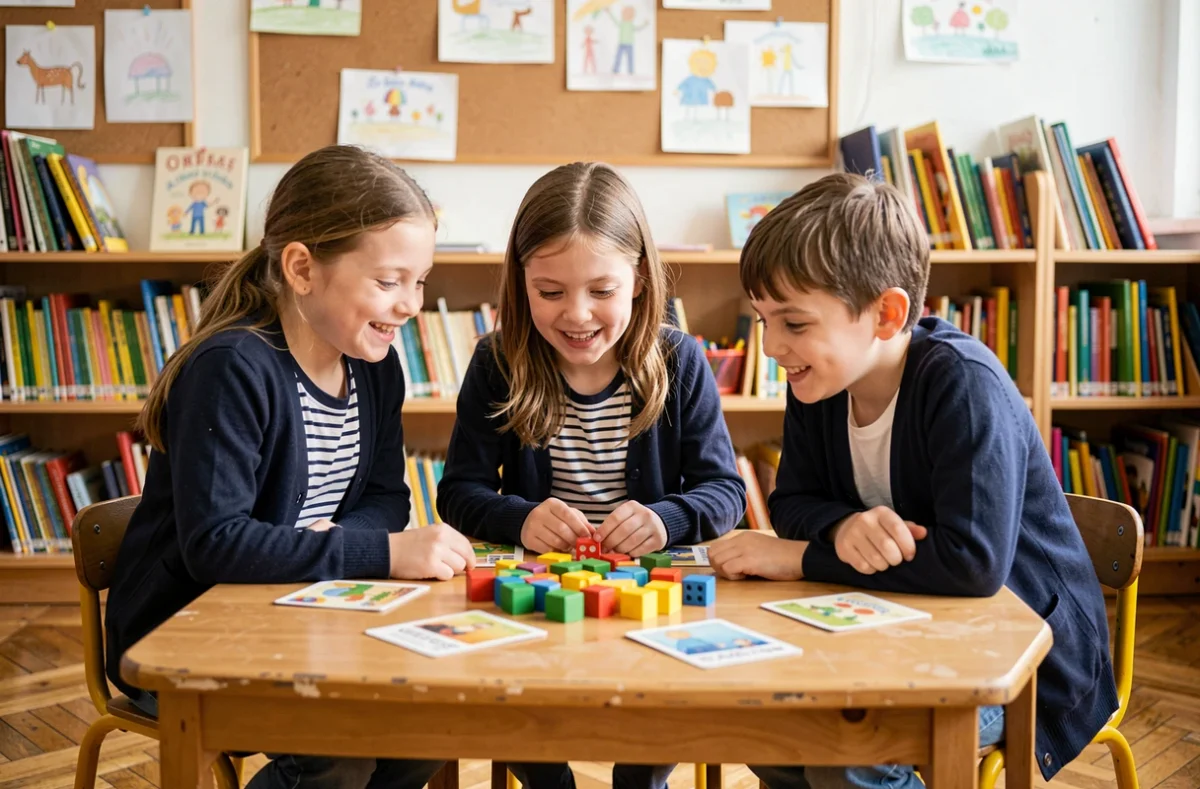
The effectiveness of games in the classroom relies less on the choice of the playful activity than on the quality of the pedagogical support surrounding it. A poorly calibrated setup, lacking explicit learning objectives or structured feedback, produces fun without lasting cognitive impact. This article details the technical conditions that shift a game from entertainment to real learning.
Support and feedback: the mechanisms that make a game educational
A game becomes a learning tool only when it incorporates an immediate feedback loop related to the educational objective. The student must perceive, during the game, the direct consequence of their choices on their progress toward the targeted competence. Without this feedback, the game engages working memory on peripheral elements (rules, winning strategy) at the expense of disciplinary content.
Support operates on three levels. Before the session, the teacher defines a measurable learning objective and selects a game whose central mechanics mobilize the target competence. During the game, they observe, prompt with targeted questions, and adjust the difficulty. After the game, a phase of structured debriefing allows students to articulate what they have learned, not what they felt.
Recent research confirms that the effect of the game strongly depends on the students’ prior knowledge and the quality of the guidance provided. A student without sufficient prerequisites in a complex game experiences cognitive overload that negates the playful benefit. We recommend differentiating game levels as one differentiates exercises, offering adapted variants for each group’s profile.
To explore the relationship between play and learning on SDN Rennes, several concrete avenues for articulating disciplinary objectives and playful mechanics are detailed.
Material organization of the classroom during a game session
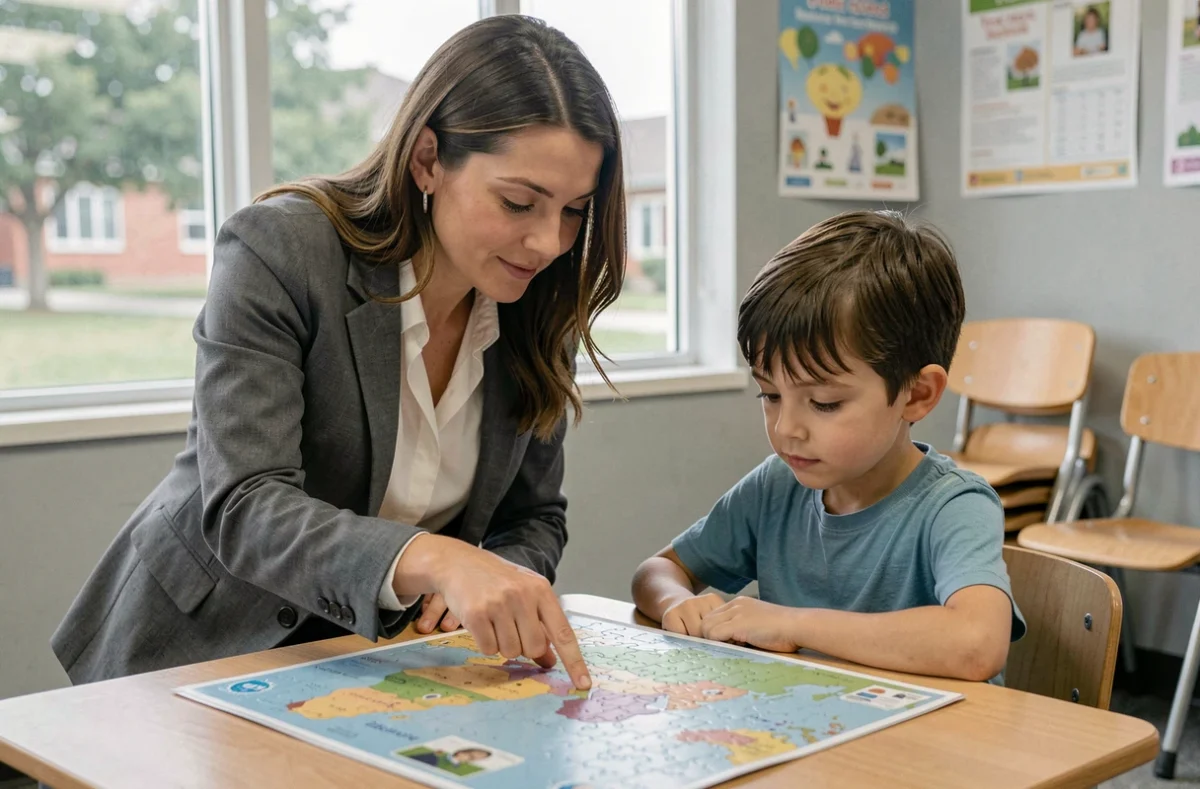
Spatial arrangement is a determining factor that pedagogical guides rarely address. A game session in the classroom requires a different physical configuration than a lecture, and this transition must be anticipated to avoid wasting effective learning time.
- Arrange tables in clusters of up to four students for board or card games, with materials ready for use before students enter the room
- Ensure sufficient circulation space so that the teacher can observe each group without interrupting the game, which conditions the quality of real-time support
- Reserve a board or display visible to all to remind students of the educational objective of the session and the success criteria, so that the game remains focused on learning
- Define a clear auditory or visual signal to mark the end of the playful phase and the beginning of the debriefing, thus avoiding vague transitions that dilute attention
The effective playtime rarely exceeds one third of the session. The remainder is divided between presenting the rules, setup, debriefing, and institutionalization. Underestimating these ancillary phases is the main cause of failure in initial attempts at playful pedagogy.
Digital game or physical game in class: concrete selection criteria
The choice between a screen game and a board game is not a matter of personal preference. It depends on the competence being worked on, the students’ level, and the material constraints of the institution.
The digital game is better suited for learning that requires spaced repetition with progressive difficulty, such as mental math or vocabulary in a foreign language. The machine adjusts the difficulty in real-time and provides instant feedback without teacher intervention, freeing up time to support struggling students.
The physical game (board, cards, dice) remains superior for skills involving negotiation, oral argumentation, or cooperation. The manipulation of concrete objects also promotes memory anchoring among students in cycle 2. A quasi-experimental study on learning fractions reports better results for the group using educational video games in conjunction with traditional teaching, confirming that digital games function as a hybrid device, not as a substitute.
On the other hand, uses based on artificial intelligence (adaptive exercises, quiz generators) introduce new risks. Research indicates persistent difficulties with the quality of automatically generated exercises and potential biases based on student profiles. We recommend manually checking each AI-generated content before use in class and cross-referencing results with traditional assessments.
Assessing learning through play without confusing enjoyment and progress
The main evaluation error consists of measuring engagement (participation, enthusiasm) rather than the competence acquired. A student may be very involved in a game and gain no measurable learning if the playful mechanics do not target the right objective.
We recommend clearly separating the evaluation of the device from the evaluation of the student:
- For the device: compare results to a formative assessment conducted before and after the game sequence, on the same disciplinary content, with an identical protocol
- For the student: use a short written exercise post-debriefing that exactly reflects the competence targeted by the game, without help from the playful support
- For the teacher: note the moments when support was necessary and the profiles of students who did not reach the objective, in order to adjust the next session
The available evidence remains focused on short interventions and immediate measures. The lack of longitudinal studies makes it difficult to assess medium-term retention. As long as this data is lacking, caution dictates not to replace explicit teaching sequences with play, but to complement them.
Integrating play into the classroom involves demanding pedagogical engineering. The playful mechanics must serve a specific objective, the material organization conditions success, and the evaluation focuses on competence, not enjoyment. Without structured debriefing, the game session does not produce usable learning traces.