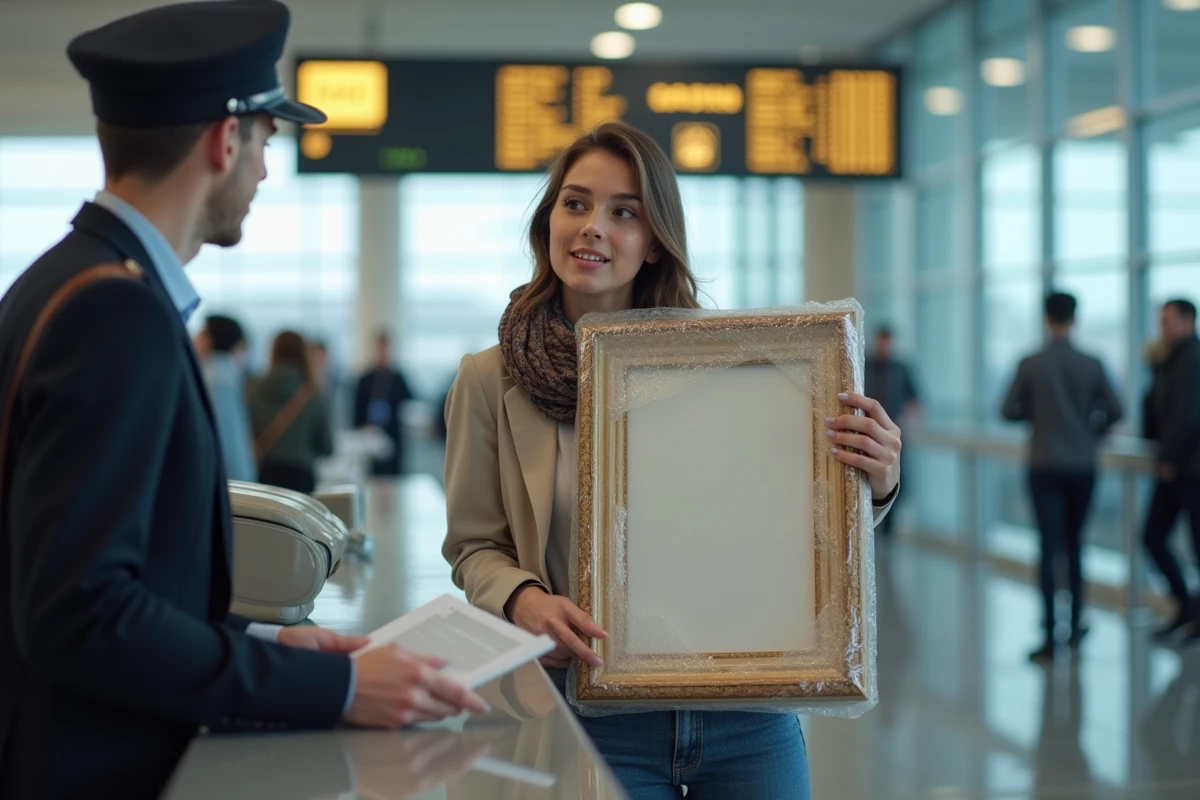
Some passengers discover too late that their painting will not fit through the boarding gate. Others find themselves paying unexpected fees for a bag deemed “oversized.” Traveling by plane with a work of art is never a formality: sudden temperature changes, humidity, repeated handling… The slightest misstep and the canvas, sometimes irreplaceable, risks being damaged before even reaching its destination.
Customs regulations, for their part, leave no room for approximation. Even when it comes to personal belongings, checks are strict and penalties for forgetfulness can lead to confiscation or fines. Packing a painting carelessly or neglecting the administrative aspect can sometimes jeopardize everything that constitutes the value of a work, insurance included.
Why transporting a painting by plane requires special attention
Flying with a work of art is not just a matter of an extra suitcase. At every stage of the journey, a painting becomes vulnerable: shocks, pressure variations, humidity, handling in the cargo hold. Airlines, each with their own constraints, impose size or packaging limits that can vary widely. Low-cost carriers, stricter than major airlines, further limit access in the cabin or cargo hold.
Maximizing material protections does not eliminate administrative complexity. At the airport, passing through customs requires precise documentation: certificate of authenticity, invoice, sometimes an ATA carnet for temporary loans, or even a CITES certificate if the painting contains regulated wood. An incomplete declaration, and the penalty falls: confiscation of the work or a fine. It is impossible to leave things to chance, even for a simple round trip.
Insuring your painting “ad valorem,” that is, based on its actual value, is essential to limit the risk of loss, breakage, or deterioration. Before handing the work over to the airline or entrusting it to security agents, taking the time to photograph every side is a reflex that protects in case of disputes.
To go further, the page tips for transporting a painting gathers concrete recommendations for each stage of the journey. Following these precautions preserves the integrity of the work and allows for a worry-free trip.
What packaging techniques truly protect your work during travel
Proper packaging is the first barrier against the unforeseen challenges of air transport. For each type of painting, the choice of materials makes all the difference. Starting with a delicate protection of tissue paper placed on the painted surface prevents abrasions. Then, bubble wrap is added, but never directly taped to the canvas: this prevents the risks of condensation or unwanted marks. Securing the whole with adhesive tape keeps a stable structure during the journey.
For the cargo hold, nothing replaces a sturdy wooden crate. The ideal is custom-made, lined with polyethylene foam, cut to fit the exact contours of the painting. This padding limits movement, absorbs shocks, and protects against jolts. A reinforced cardboard box can be suitable for a short trip or cabin transport, provided that protective corners and meticulous seals are added.
Unframed paintings, on the other hand, preferably travel rolled in a rigid shipping tube or a padded envelope. Simply rolling the canvas onto an appropriate support, especially without folding it, preserves its integrity. Before sealing the package, photographing the work from all angles provides valuable evidence in case of an insurance claim. Including a detailed inventory inside will facilitate customs checks and speed up procedures if necessary.
Here are the elements to consider for truly protective packaging:
- Tissue paper and bubble wrap to protect the painting without damaging it
- Wooden crate or reinforced cardboard to form the external structure
- Polyethylene foam to absorb shocks and limit vibrations
- Shipping tube or padded envelope for soft or unframed works
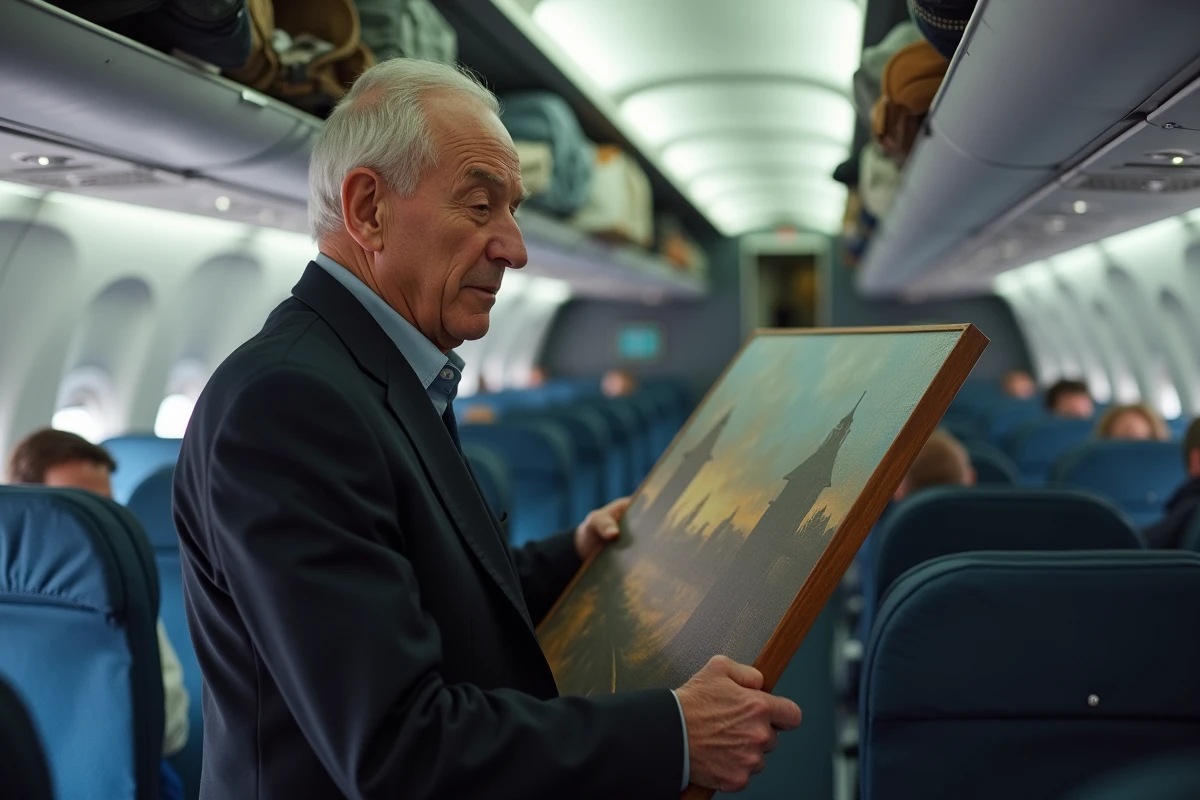
Checks and procedures not to neglect before boarding
Transporting a painting by plane is primarily a matter of preparation. Before arriving at the airport, it is essential to gather every document: certificate of authenticity, purchase invoice, condition report. These documents simplify security checks and provide the necessary proof in case of discussions with customs authorities.
The customs declaration is non-negotiable when crossing a border with a work of art. Depending on the destination and the materials used, it may involve obtaining an ATA carnet for a temporary loan or a CITES certificate for paintings containing exotic wood. The conditions set by the airline also deserve full attention: dimensions and weight of cabin luggage, check-in procedures, packaging requirements. Some even require insurance covering all risks.
To enhance the security of cargo transport, a TSA strap and an approved lock prove useful. Carefully labeling the package avoids many confusions upon arrival. Keeping a damage report handy to fill out in case of an incident speeds up procedures. Finally, creating an archive of dated photos of the painting and its packaging ensures irrefutable proof if any problems arise.
Before leaving, keep in mind these essential checks:
- Take precise photos of the painting before boarding
- Check the restrictions on cabin luggage (dimensions, allowed weight)
- Always keep valuable items and essential medications with you
- Use apps like My TSA to anticipate airport constraints
Planning each step gives your painting the best chance to cross borders without issues. And to return, upon arrival, with the certainty of having outsmarted the pitfalls of air travel.